

Understanding Ragdoll Cat Colors: A Guide to Patterns, Colors, and Genetics
Why Ragdoll Kittens Are Born White
One of the most fascinating things about Ragdoll cats is that they are born almost completely white.
Unlike many other breeds, Ragdoll kittens don’t arrive with their final color already in place. Instead, their coats gradually transform over the first weeks and months of life, slowly revealing the rich color and distinctive patterns they’re known for.
So why does this happen?
The answer lies in a unique genetic trait known as the colorpoint gene, which makes a cat’s coat color temperature sensitive. In the warmth of the womb, pigment development is largely suppressed, which is why kittens are born pale. As they grow and different areas of their body cool at slightly different rates, color begins to emerge — first on the face, ears, legs, and tail, and later across the rest of the body.
Because of this, every Ragdoll kitten remains a work in progress, developing its own unique expression of color and pattern over time.
In this guide, we’ll explore the full range of traditional Ragdoll colors, explain how genetics shape each variation, and break down the patterns and combinations that make this breed so visually captivating — in a way that’s clear, approachable, and easy to understand.
Ragdoll Colors and Patterns at a Glance
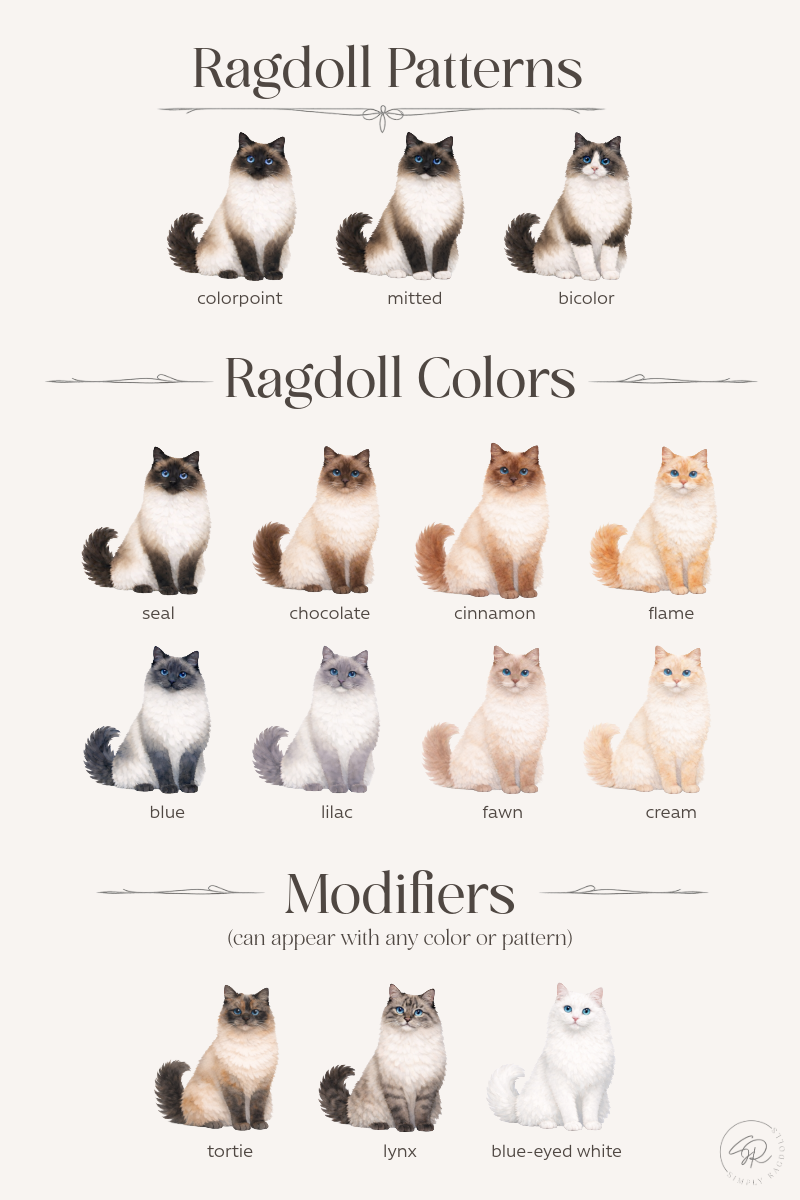
This visual highlights the range of patterns, colors, and modifiers recognized within the breed.
Understanding Ragdoll Patterns: Colorpoint, Mitted & Bicolor
Ragdoll cats are classified by both color and pattern. While color refers to the pigment itself, pattern describes how white is distributed across the coat. Traditional Ragdolls fall into three primary pattern categories: colorpoint, mitted, and bicolor.
These patterns are controlled by the white spotting gene, which influences how much — and where — white appears on the cat’s body. Rather than acting as an on/off switch, this gene functions more like a gradient, creating a wide range of beautifully unique markings.
As a result, pattern inheritance is predictable in broad terms, but variable in individual kittens, which is why even littermates can display noticeably different markings.
Colorpoint
This is the original Ragdoll pattern and provides the cleanest expression of the colorpoint gene as colorpoint Ragdolls display no visible white spotting.
Typical characteristics include:
Fully colored mask, ears, legs, and tail
No white on the paws, chin, or belly
Soft contrast between the darker points and lighter body
Mitted
Mitted Ragdolls carry a low expression of the white spotting gene, resulting in small, consistent areas of white. Mitted cats retain the classic pointed look while adding white accents that give them a distinctive charm.
Common features include:
White “mittens” on the front paws and “boots” on the back legs
White chin, bib, and belly
Occasionally a thin blaze on the nose
Bicolor
Bicolor Ragdolls express a higher degree of white spotting, creating more dramatic contrast and larger areas of white. Because the white spotting gene can express at varying levels, bicolor patterns can range from moderate white to very high white, making each cat’s markings unique.
Typical markings include:
An inverted white “V” on the face
White chest, belly, and legs
More extensive white coverage on the body is possible
While patterns describe where color appears, understanding how those colors are genetically produced explains why Ragdolls display such remarkable variety.
How Ragdoll Colors Work: A Simple Guide to Genetics
You don’t need a science degree to understand Ragdoll color genetics — but knowing a few basic principles helps everything make sense.
Base Colors
The foundation of Ragdoll color begins with two primary pigment families:
Black-based colors → seal and its variations
Red-based colors → red (flame) and cream
Black-based colors range from the deep, rich brown of seal to the lighter, medium brown of chocolate and the lighter, warmer brown of cinnamon. Red-based colors appear as warm orange (flame) or its softer dilute form, cream.
Within the black-based group, seal represents the dominant expression. Chocolate is recessive to seal, and cinnamon is recessive to both seal and chocolate. Because recessive colors only appear when a kitten inherits the gene from each parent, chocolate and cinnamon tend to be seen less frequently in many breeding programs.
All of these colors — across both pigment families — are part of the recognized Ragdoll color palette and reflect the natural genetic diversity within the breed.
Dilution
In addition to base color, Ragdoll coats can also be affected by the dilution gene, which softens and lightens pigment.
When dilution is present:
Seal becomes blue
Chocolate becomes lilac
Cinnamon becomes fawn
Red (flame) becomes cream
Like chocolate and cinnamon, dilution requires recessive inheritance from both parents. When both parents carry dilution, some kittens may inherit the softened version of the base color, resulting in the cooler, lighter tones commonly described as blue, lilac, fawn, or cream.
This is why a single litter can sometimes include both richer and softer shades within the same color family.
Red (Flame) & Cream: The Sex-Linked Gene
While black-based colors and dilution follow straightforward dominant and recessive patterns, the red gene behaves a little differently.
In cats, the red gene is sex-linked, meaning it is carried on the X chromosome. Because of this, color inheritance can vary depending on whether a kitten is male or female.
Male cats (XY) have only one X chromosome. If that X carries red, the male will appear red (flame) or cream if diluted.
Female cats (XX) have two X chromosomes. If one carries red and the other carries a black-based color, both pigments can be expressed — resulting in a tortie pattern.
For a female kitten to be solid red (flame) rather than tortie, she must inherit a red gene from both parents. Without a red or cream male contributing that gene, female flame kittens are not possible, which is why male flame kittens are typically more common.
Another subtle difference in how red pigment behaves is that even in genetically solid cats, faint striping is often visible in red or cream coats. This occurs because red pigment does not suppress tabby patterning as completely as black-based pigment does.
Tortie
As mentioned above, when a female kitten inherits one X chromosome carrying red and the other carrying a black-based color, she will develop a tortie pattern.
During early development, one of the two X chromosomes in each cell is randomly “turned off.” This process, called X-inactivation, creates a mosaic effect — patches of red alongside patches of seal, chocolate, blue, or lilac. The placement and balance of color are entirely random, which is why no two torties ever look exactly alike.
Male torties are extremely rare. Because males typically have only one X chromosome, they can express either red or a black-based color, but not both. In uncommon cases where a male inherits an extra X chromosome (XXY), a tortie male can occur due to this chromosomal variation.
Lynx
In addition to base color and white patterning, some Ragdolls also carry the lynx gene, which adds tabby striping to the coat.
Lynx does not change the underlying color — instead, it overlays soft striping across the points. You may notice faint or distinct striping on the face, legs, and tail. One of the hallmark signs of a lynx Ragdoll is the appearance of a pale “eyeliner” tracing the outer corners of the eyes, along with light-colored ear rims that give the ears a framed look.
Because red pigment can show faint striping eve in non-lynx cats, careful evaluation (and sometimes genetic testing) may be needed to confirm true lynx patterning in red or cream Ragdolls.
Like torties, lynx can appear in combination with any of the base colors and patterns, resulting in names such as seal lynx colorpoint or blue lynx bicolor.
Blue-Eyed White
Most Ragdoll colors develop through visible pigment and pattern, but blue-eyed white follows a different genetic pathway. Rather than modifying where color appears, it prevents pigment from forming across the coat altogether, resulting in a fully white coat.
Importantly, this gene masks the underlying color rather than replacing it — meaning that genetically, a blue-eyed white Ragdoll still carries one of the traditional colors, even though that color is not visible externally.
Because pigment development is closely linked to hearing development, blue-eyed white Ragdolls have a higher incidence of congenital deafness compared to pointed Ragdolls — a well-documented association in cats lacking pigment. Responsible breeding practices include thoughtful pairing and early evaluation to ensure overall health and well-being.
Mink, Sepia & Solid — A Quick Overview
While traditional Ragdolls are defined by their pointed patterns and gradual color development, mink, sepia, and solid variations differ in the way color develops across the coat, resulting in darker overall coloring and softer contrast between body and points. To distinguish them from traditional pointed Ragdolls, TICA reclassified these cats in 2025 into a separate breed group called Cherubim, reflecting their distinct appearance while acknowledging their shared ancestry.
A deeper discussion of Cherubim variations will be explored separately.
Whether discussing traditional pointed Ragdolls or related variations, understanding the genetics behind their colors doesn’t take away from their beauty — it deepens the appreciation for it. From the way pigment responds to temperature, to the quiet mathematics of recessive inheritance, to the randomness that makes every tortie one of a kind, each kitten’s coat tells a story. What may look like simple color at first glance is actually a carefully layered expression of biology, history, and thoughtful breeding, slowly revealed over time.
